


Yes, but not yet. The EU’s 2024 Construction Products Regulation brings in a Digital Product Passport (DPP) for construction products, and two things have to happen before any product needs one. As of mid-October 2026, neither had happened for any product.
What has to happen first?
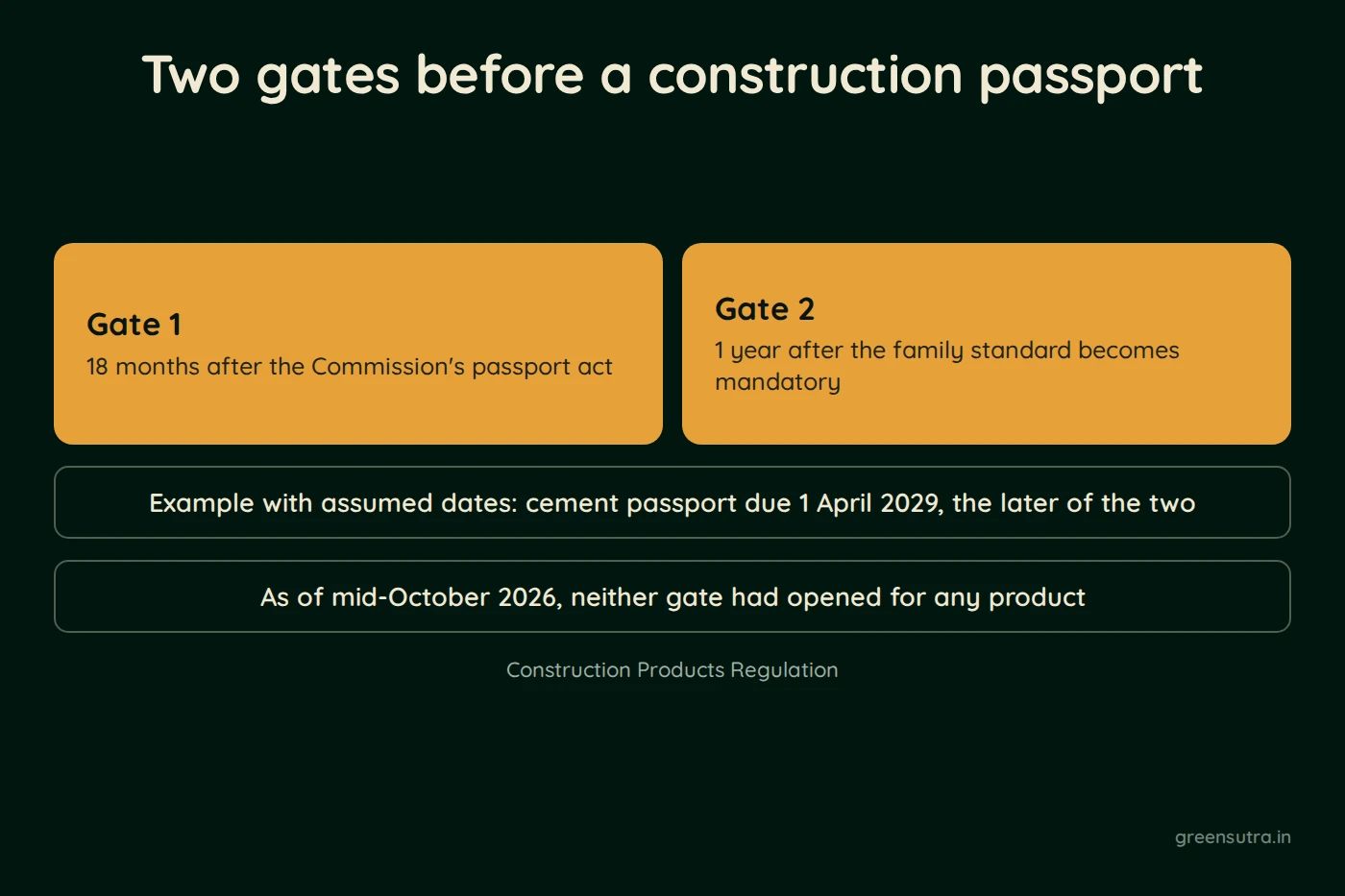
First, the Commission adopts its act setting up the passport system. The duty starts 18 months after that act takes effect; manufacturers can use the system voluntarily from six months.
Second, the product’s family has to move under the 2024 rules. That happens one year after the Commission makes a harmonised standard mandatory for the family. Products still covered by standards from the old 2011 rules need no passport.
The passport is due from whichever of the two dates comes later.
When might cement need one?
Cement is among the first families planned to move under the new rules. The Commission’s indicative plans put the passport act in the second quarter of 2027 and a mandatory cement standard in the last quarter of 2027.
Example, with assumed dates: if the passport act takes effect on 1 October 2027, the duty can apply from 1 April 2029. If the cement standard is made mandatory on 31 December 2027, cement moves under the new rules on 31 December 2028. The cement passport is then due from 1 April 2029, the later date.
What will it contain?
The passport becomes the way construction product documents reach buyers and authorities: the declaration of performance and conformity, the technical documentation, the label, instructions and safety information. Where a key part has its own passport, the product’s passport links to it. A product exempt from the declaration of performance needs no passport. Each passport must stay available for at least 10 years.
Will customs check it?
Not automatically, as they will for toys and detergents. Customs can still hold goods whose required documents are missing. A manufacturer outside the EU must appoint an authorised representative in the EU, who checks the passport documentation.
Where this comes from: Construction Products Regulation (EU) 2024/3110, Articles 14, 22, 23, 75, 76, 80, 91 and 95; CPR Working Plan 2026 to 2029, COM(2025) 772; European Commission, Digital Product Passport page; Regulation (EU) 2019/1020.