


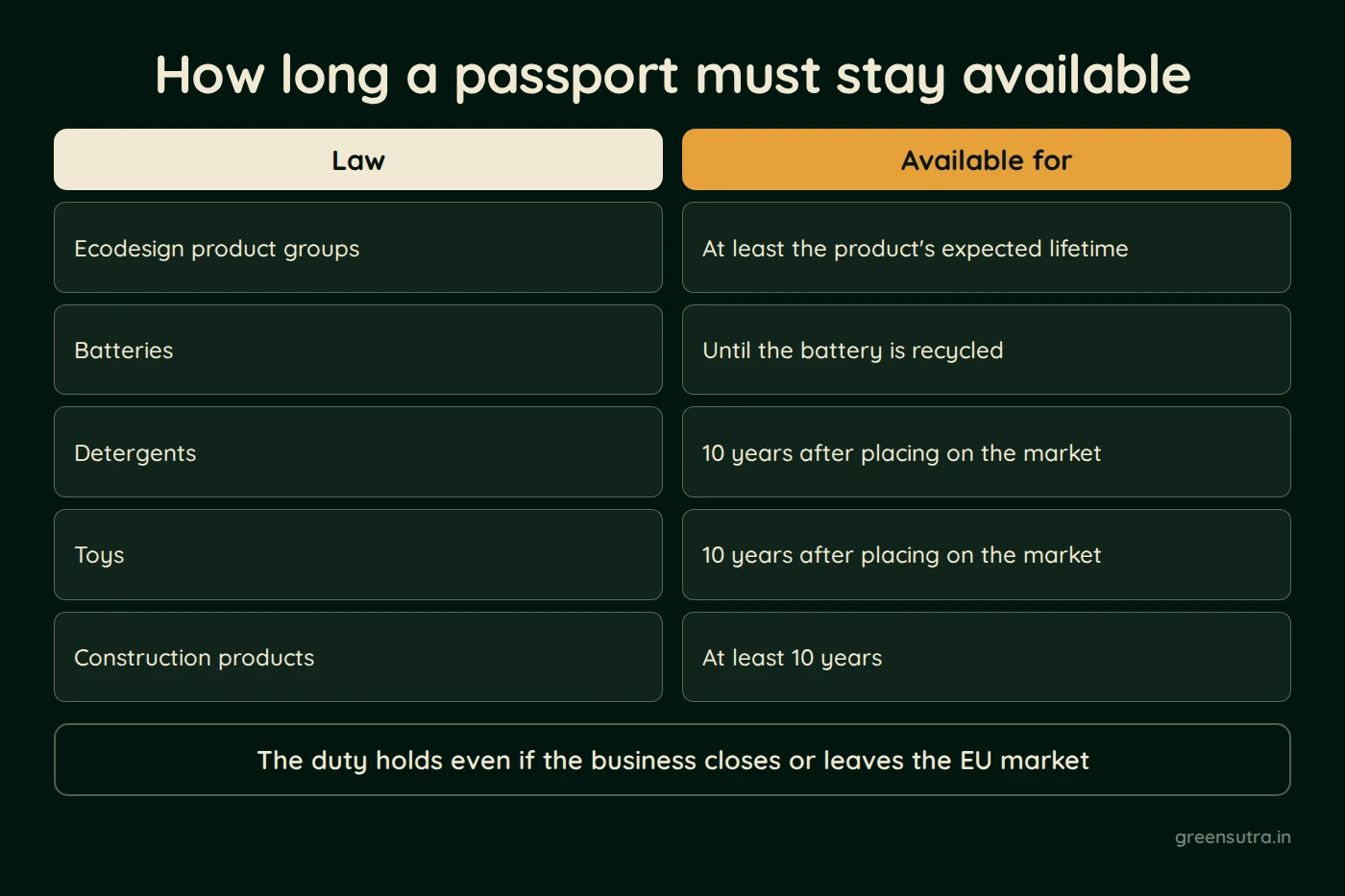
At least as long as the product is expected to last. That is the minimum the EU’s Ecodesign Regulation sets for a Digital Product Passport (DPP), and each product group’s rules fix the exact period. Some laws are already specific. Toy and detergent passports must stay available for 10 years after the product is placed on the market, and a battery passport lasts until the battery is recycled.
What if the company behind it closes?
The passport has to outlive it. The obligation holds even if the business goes insolvent, is liquidated or stops trading in the EU. A back-up copy of the latest version must also sit with an independent DPP service provider. The same holds for toy and detergent passports. The battery law has no back-up rule, but it also requires the passport to survive the business.
How long under each law?
| Law | How long the passport must stay available | Passport due |
|---|---|---|
| Ecodesign Regulation | Set for each product group, at least the expected lifetime | No product group yet |
| Batteries | Until the battery is recycled | 18 February 2027 |
| Detergents | 10 years after it is placed on the market | 23 September 2029 |
| Toys | 10 years after it is placed on the market | 1 August 2030 |
| Construction products | At least 10 years | 18 months after the Commission’s passport act |
For construction products, the passport system itself must stay accessible for 25 years after the last product of a type is placed on the market. See which products need a passport first for the dates.
Does the EU registry keep the record as long?
The EU registry keeps registration data for as long as EU law requires. Where the law sets no period, it deletes the data automatically 10 years after registration. A registered passport can also pass to another verified business, which then takes over the duties.
Is this the same as the 10-year rule for technical files?
No. Separately, a manufacturer must keep the technical documentation and the EU declaration of conformity for 10 years, unless a product group’s rules set another period. That is a record-keeping duty, not a passport rule.
Where this comes from: Ecodesign Regulation (EU) 2024/1781, Articles 9(2)(i), 10(4), 11(e) and 27, and Annex III; Battery Regulation (EU) 2023/1542, Articles 77(8) and 78; Detergents Regulation (EU) 2026/405, Article 21; Toy Safety Regulation (EU) 2025/2509, Article 19; Construction Products Regulation (EU) 2024/3110, Articles 22 and 75; Implementing Regulation (EU) 2026/1778, Article 10(3).