


That depends on the product. The EU has not given any business a general right to edit a Digital Product Passport (DPP). Each product group’s rules will say who may add or change what, and as of October 2026 no such rules exist under the Ecodesign Regulation. Batteries are further ahead: their law already says who takes over the passport when a battery is remanufactured or becomes waste.
Who decides?
The rules for each product group. They will name who creates the passport, who may update it and which data each may touch. Nobody can go beyond the rights those rules give, and that includes a DPP service provider hosting the data. The toy, detergent and construction products laws also leave this to later acts, none adopted yet; see which products need a passport first.
Will repairers and recyclers be able to add data?
That is the intention. The non-binding recitals of the Ecodesign Regulation say professional repairers and recyclers should be able to access, add or update data, and they mention refurbishers, remanufacturers and independent operators too. Whether they actually can will depend on each product group’s rules. More on what repairers and recyclers can see.
What happens when a product is changed or remanufactured?
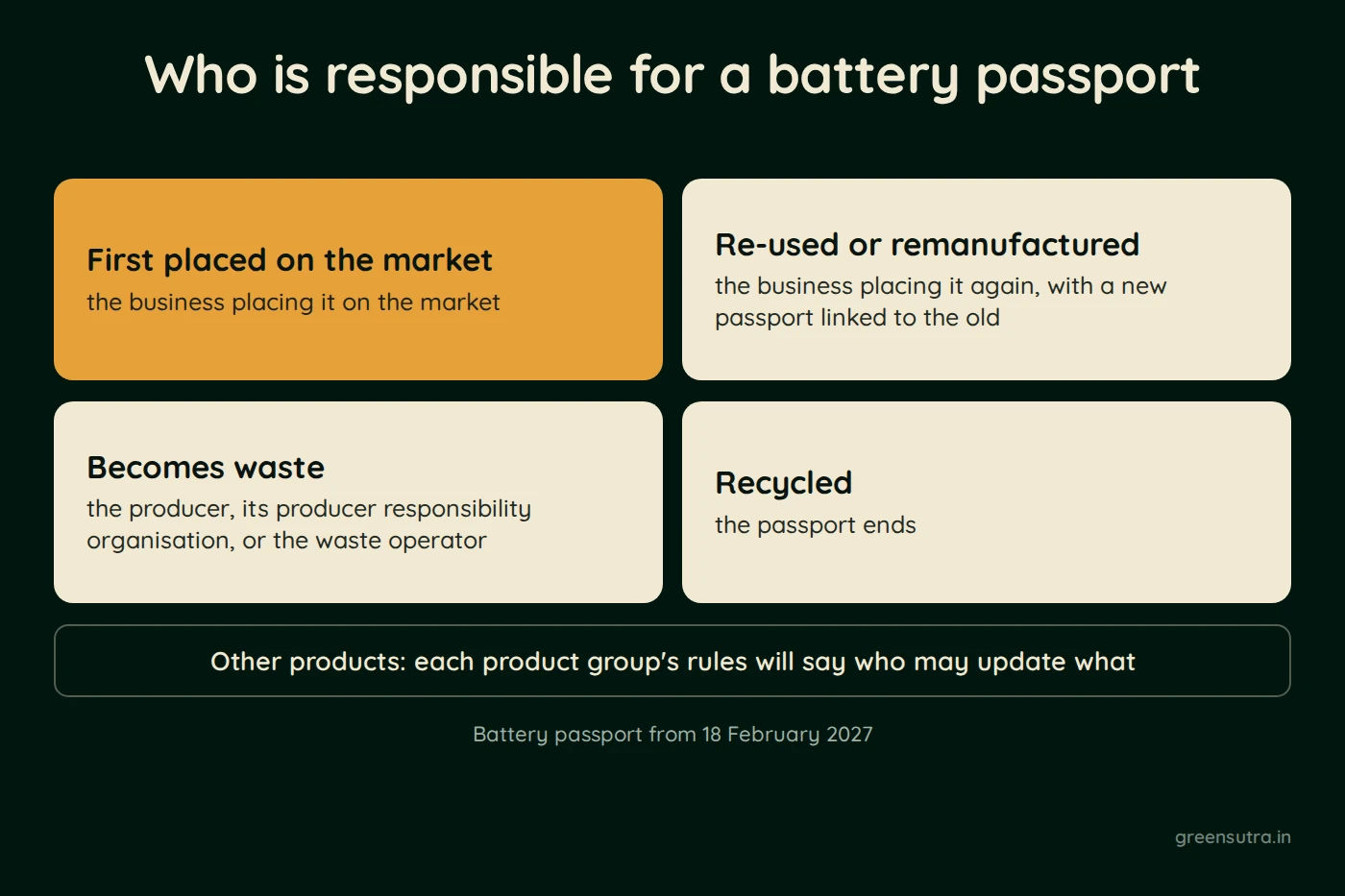
If a new passport is created for it, the new one must link back to the original; for batteries, a new passport is required, as the table shows. An importer or distributor that changes a product in a way that affects its compliance becomes its manufacturer, with the duties that come with it.
For the battery passport, due from 18 February 2027, the hand-overs are already set:
| What happens to the battery | Who is responsible for the passport |
|---|---|
| First placed on the market | The business placing it on the market (another business may act for it under written authorisation) |
| Re-used, repurposed or remanufactured | The business placing it on the market again, with a new passport linked to the old one |
| Becomes waste | The producer, its producer responsibility organisation, or the waste management operator |
| Recycled | The passport ends |
Can a registered passport pass to another business?
Yes, once registration opens. The new holder must be verified in the EU registry and takes over the duties from the date of transfer. The registry keeps a record of every change.
Where this comes from: Ecodesign Regulation (EU) 2024/1781, Articles 9(2)(g), 11 and 34, and recital 32; Construction Products Regulation (EU) 2024/3110, Article 75; Battery Regulation (EU) 2023/1542, Article 77; Implementing Regulation (EU) 2026/1778, Article 6a.