


Not a GTIN as such. A GTIN, the number behind most retail barcodes, is not required by any EU passport law adopted so far. What every Digital Product Passport (DPP) does need is a unique product identifier: a permanent code that ties the physical product to its passport. A product group’s rules may later ask for a GTIN or allow one to be used.
Can an existing GTIN be used?
Alongside the identifier, yes, where the rules allow it. The Ecodesign Regulation lists the GTIN, “or equivalent”, among the details a product group’s rules can require. It lists the unique product identifier as a separate item, so a GTIN does not replace it. The EU battery passport does not ask for a GTIN either.
Which identifiers can a passport use?
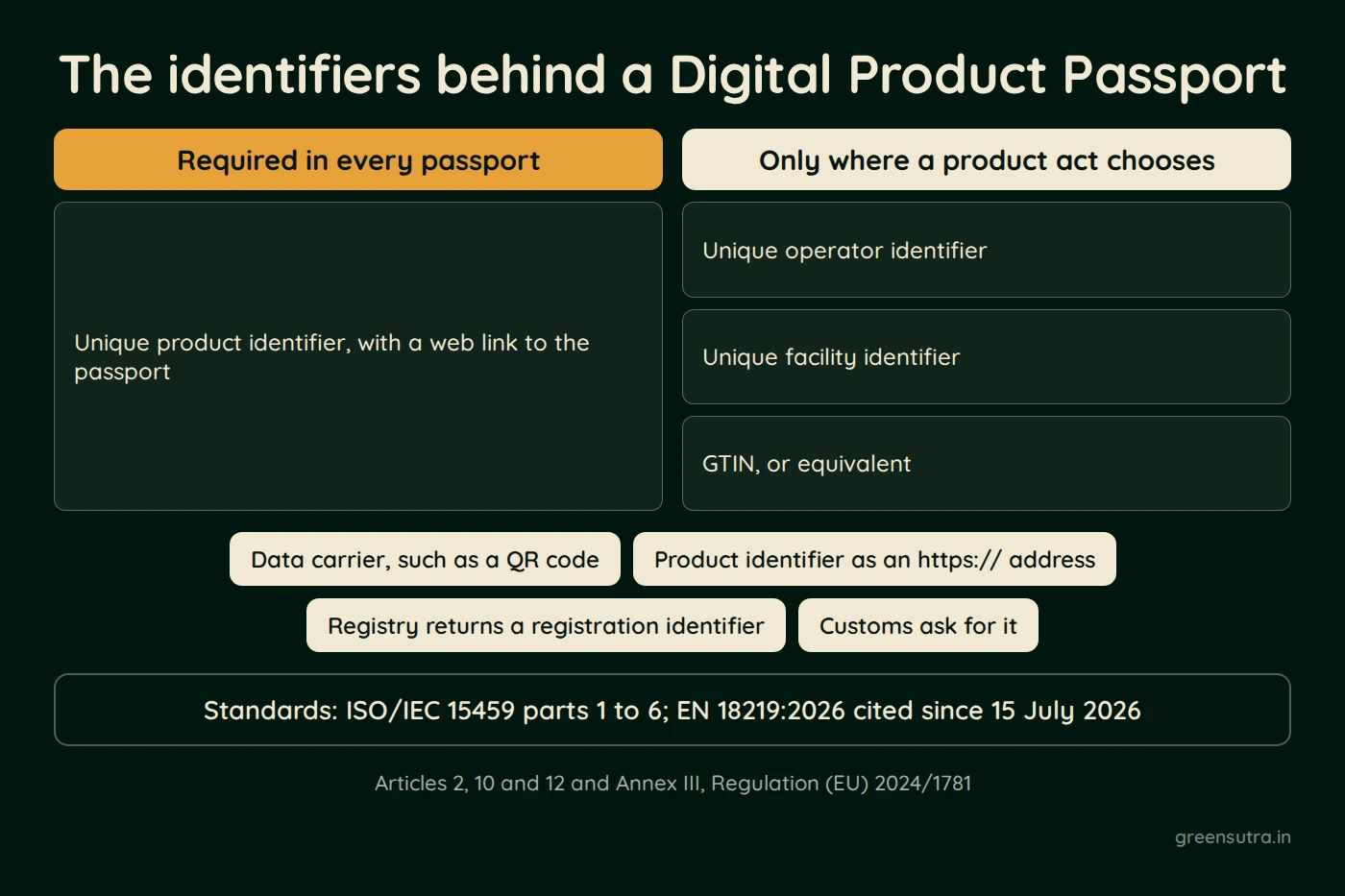
| Unique product identifier | The product, as a model, batch or single item, with a web link to its passport | Always |
|---|---|---|
| Unique operator identifier | A business in the supply chain, such as the manufacturer or a supplier | If the product group’s rules ask for it |
| Unique facility identifier | A factory, site or building in the supply chain | If the product group’s rules ask for it |
A carrier such as a QR code on the product holds the product identifier.
Which standard should the identifier follow?
The Ecodesign Regulation names the ISO/IEC 15459 series or equivalent. Since 15 July 2026, the EU has also cited EN 18219, a European standard for unique identifiers, which gives a presumption of conformity. Whether it now replaces ISO/IEC 15459 is not settled.
What if a supplier has no identifier?
The business creating the passport requests one for the supplier, after checking that none exists, and passes on the details once it is issued.
What does the EU registry do with it?
The registry takes the product identifier as a web address. In return it issues a different number, the registration identifier, and that is the number customs ask for at the border. As of October 2026, the registry was live but could not yet accept passport registrations.
Where this comes from: Ecodesign Regulation (EU) 2024/1781, Articles 2, 10, 12, 13 and 15 and Annex III; Implementing Decision (EU) 2026/1736; Battery Regulation (EU) 2023/1542, Article 77; DPP Registry user guide v1.03.