


A trader has CBAM duties under Regulation (EU) 2023/956 only as the importer of the goods or as an importer’s indirect customs representative. Above 50 tonnes of CBAM goods a year, the importer needs authorised declarant status or an indirect customs representative holding it. Buying goods already cleared in the EU creates no duty.
Does CBAM have a separate category for traders?
No. CBAM duties fall on the authorised CBAM declarant: the importer, defined in Article 3(15), or an indirect customs representative acting for it. The operator, defined in Article 3(31), operates or controls an installation outside the EU and takes on duties only if it registers under Article 10. A trader is rarely an operator, so the customs declaration decides its role.
Which trading positions carry a CBAM duty?
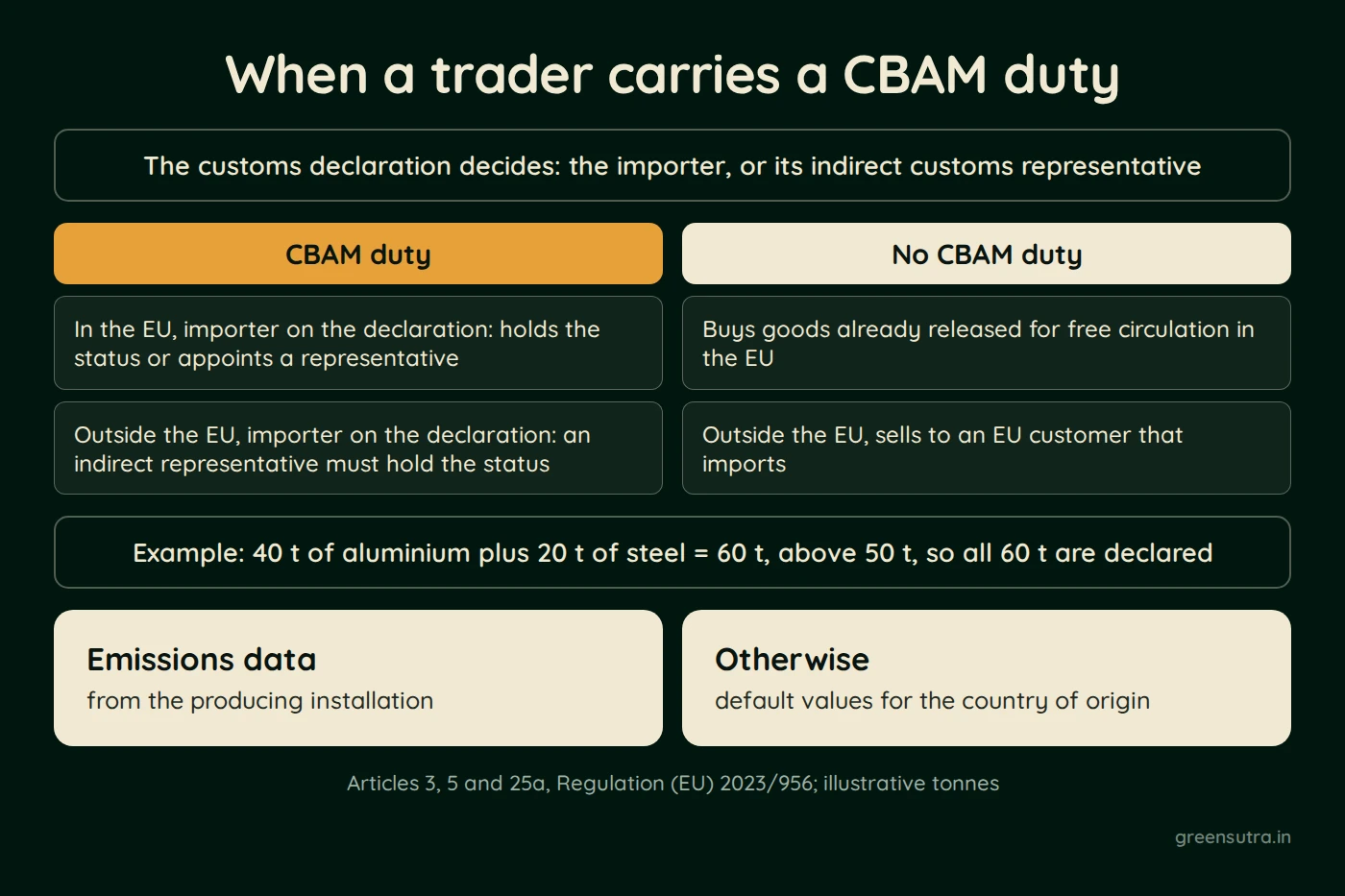
The customs declaration, set by the sale terms, decides who carries the duty: the importer or its indirect customs representative.
| Trader’s position | CBAM duty |
|---|---|
| In the EU, importer on the customs declaration | It holds the status or appoints an indirect customs representative that agrees to act |
| Outside the EU, importer on the customs declaration | It cannot hold the status; Article 5(2) requires an indirect customs representative that does |
| Buys goods already released for free circulation in the EU | None for those goods |
| Outside the EU, sells to an EU customer that imports | None; the customer or its representative declares |
What does a trader that imports have to do?
The same as any declarant. The 50 tonne exemption counts per importer and calendar year, all CBAM goods together, and never covers electricity or hydrogen. Article 25a(4) disregards non-genuine arrangements that split imports to stay under it; they count as a serious infringement. A trading company not established throughout the two financial years before the year it applies must lodge a guarantee. Certificates “cannot be transferred nor sold to another person”, the Commission’s CBAM Q&A says, even within a group.
Example: an EU trading company clears an illustrative 40 tonnes of aluminium and 20 tonnes of steel in its own name in 2026. The threshold counts all CN codes together, so all 60 tonnes are declared. Bought after customs release, the same goods leave it nothing to declare.
Where does a trader get emissions data?
From the producing installation. A trader that neither operates nor controls an installation cannot register installations in the CBAM registry. The Commission’s Guidance Document No. 1 notes that intermediary traders “would have to forward the request to the operator of the installation”, which supplies the verified installation data. Otherwise the declarant uses default values, set by the goods’ country of origin, not the trader’s country.
The Commission has proposed, in COM(2025) 989, that declarations on actual emissions for goods it selects carry evidence that the goods came from the declared installation. On 19 October 2026 the proposal still awaited Parliament’s first-reading position.
Sources: Regulation (EU) 2023/956, Commission CBAM Q&A, Introduction to CBAM concepts, Proposal COM(2025) 989, Legislative Observatory)
For a trading company, GreenSutra’s CBAM service starts from who clears each shipment, then prepares the installation data that an accredited verifier checks. It does not verify. The CBAM guide covers the declarant’s duties.