

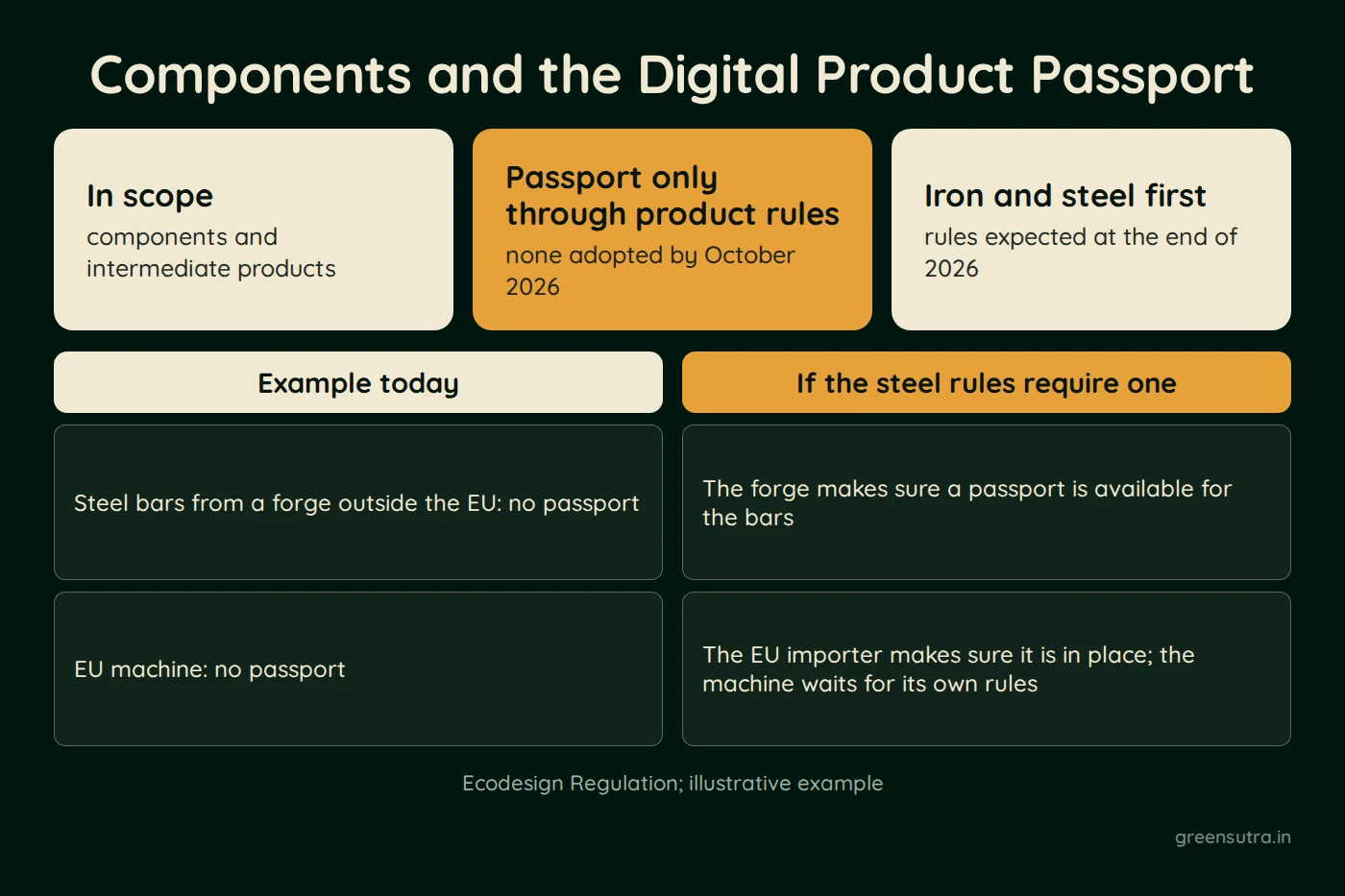
They can, but only once the EU writes passport rules for their product group. The Ecodesign Regulation covers components such as gears and bolts, and intermediate products such as steel bars or aluminium sheet, not just finished goods. As of October 2026, no group has its passport rules yet. Iron and steel are first in line, with rules expected at the end of 2026.
Does selling to another business count?
Yes. The rules apply when a product is first supplied on the EU market, whether the buyer is a household or a factory. A part shipped into the EU on its own is placed on the market by its importer. A part already built into a finished product abroad arguably enters with that product, though no official text says so.
An example: steel bars for a machine
A forge outside the EU sells steel bars to a machine manufacturer in Germany. Today, neither the bars nor the machine needs a passport. Once the steel rules apply, and if they ask for one, the forge as manufacturer must make sure a passport is available for the bars. The EU importer of the bars must make sure it is in place too. The steel rules will also say who actually creates it. The machine waits for rules of its own.
What about suppliers further back?
They are drawn in through their customers. Where a product group’s rules say so, businesses in the supply chain must, on request and free of charge, give manufacturers and authorities the relevant information they hold. The Commission’s early work on steel even floats passport requirements for every business in the chain, though nothing is decided.
Do battery cells need their own passport?
No. The Commission’s battery passport page puts the duty on whoever places the finished battery on the market, not on the suppliers of individual components or modules.
Where this comes from: Ecodesign Regulation (EU) 2024/1781, Articles 1(2), 2(39) and (40), 9, 27(1)(c), 29(2) and 38; ESPR Working Plan COM(2025) 187; steel initiative 17672; European Commission, DPP for batteries.