

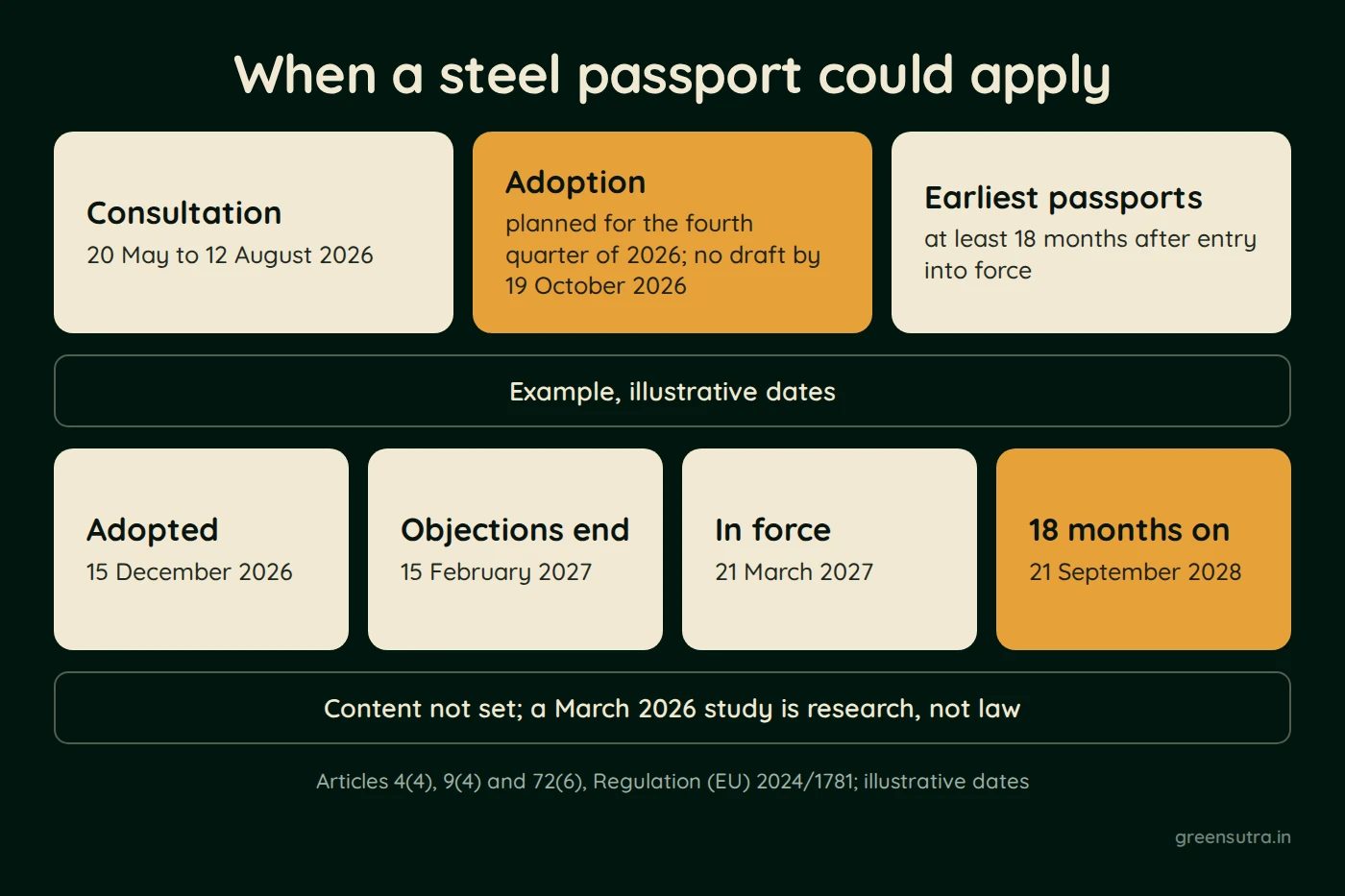
Iron and steel will need a Digital Product Passport once the EU adopts its ecodesign rules for steel, which the Commission plans for the last quarter of 2026. The passport would apply about 18 months after those rules take effect, so adoption in December 2026 points to passports from around September 2028. What the passport will hold is not settled.
Have the steel rules been adopted?
Not yet. The Commission’s consultation on the steel rules ran from 20 May to 12 August 2026, and on 22 October 2026 its draft had still not been published. The Commission calls its fourth-quarter target indicative. Its working plan puts iron and steel first among the intermediate products in the priority product groups.
Will the steel rules include a passport?
Yes, unless the Commission uses the one exemption. The EU’s Ecodesign Regulation makes a passport part of every set of product rules. The Commission can leave it out only when the technical standards are missing or another EU law already gives an equivalent digital record. The Commission’s steel page lists manufacturers, producers and importers among those who could carry the passport duty. Steel made outside the EU, such as coils from a mill in another country, would be covered through the EU importer.
When could a steel producer need a passport?
Eighteen months is the usual minimum, and the Commission can set an earlier date only with a stated reason. The clock also starts late. Once adopted, the rules wait two months, or up to four, while the European Parliament and the Council decide whether to object.
Example, with illustrative dates.
- The Commission adopts the rules on 15 December 2026.
- Nobody objects, and the two months end on 15 February 2027.
- The rules are published on 1 March 2027 and take effect on 21 March 2027.
- Eighteen months later, passports apply from 21 September 2028.
What will a steel passport hold?
Nothing is fixed. The Commission is weighing information on carbon footprint, recycled content and substances that make steel harder to recycle. It is also looking at performance classes and at passport duties “for all actors involved in the supply chain”.
A March 2026 study by the Joint Research Centre, the Commission’s science service, makes these proposals. They are research, not law:
- the heat number as the batch identifier, with item serial numbers optional for products such as coils;
- product number, commodity codes, steel grade and technology route;
- operator and facility identifiers, country of origin and manufacturing date;
- substances of concern, a product carbon footprint and recycled content.
Much steel also ends up in buildings, so the study asks for the steel passport to work with the construction products passport.
Is the steel passport a CBAM report?
No. The working plan says the ecodesign rules sit alongside CBAM, and the study lists a CBAM reference only as an optional extra. Which steel goods CBAM covers is a separate question.
The Commission’s planned quarter for steel sits on the Digital Product Passport timeline, which gains a firm date once the rules are published.
Where this comes from: Ecodesign Regulation (EU) 2024/1781, Articles 4(4), 7(2), 9(4) and 72(6); Working Plan COM(2025) 187; steel initiative 17672; Commission page on passports for iron and steel; Joint Research Centre steel passport study.