

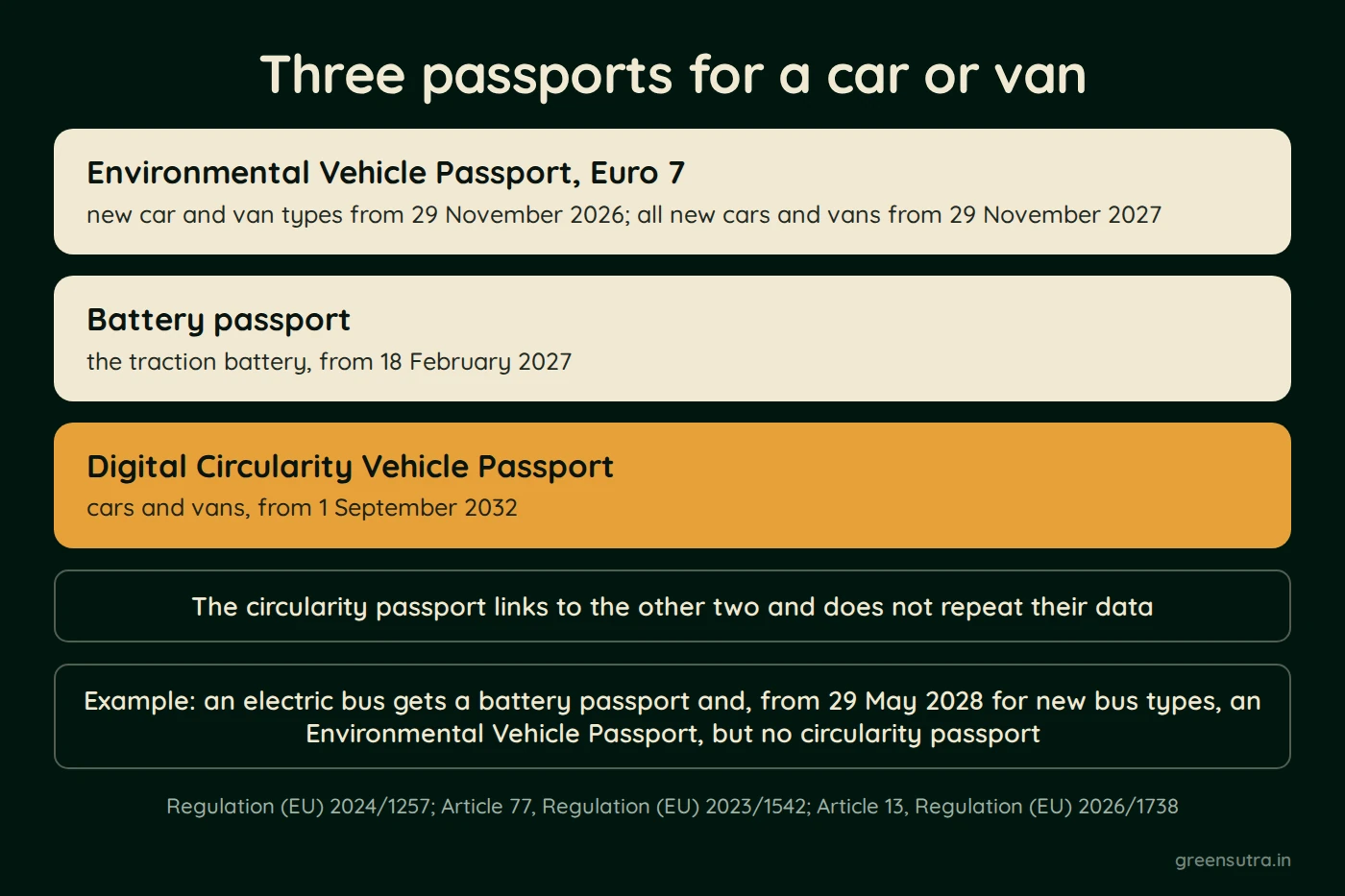
A new car or van can carry three EU passports. They are the Environmental Vehicle Passport under Euro 7, a battery passport for its traction battery, and a Digital Circularity Vehicle Passport. The first starts on 29 November 2026 for new car and van types, the battery passport on 18 February 2027 and the circularity passport on 1 September 2032.
Which law sets each passport?
| Passport | Law | Starts | Covers | Held by |
|---|---|---|---|---|
| Environmental Vehicle Passport | Euro 7 Regulation | New car and van types: 29 November 2026. Every new car and van: 29 November 2027 | Environmental performance at registration | The vehicle manufacturer |
| Battery passport | Batteries Regulation | 18 February 2027 | The traction battery | The business placing the battery on the market |
| Digital Circularity Vehicle Passport | End-of-Life Vehicles Regulation | 1 September 2032 | How to remove and replace parts, recycled content, the spare parts catalogue | The manufacturer placing the vehicle on the market |
Other products have dates of their own, listed in the passport date list.
What does the Environmental Vehicle Passport show?
It records how the vehicle performed when it was registered: pollutant emissions, CO2, fuel and electricity use, electric range, power and battery durability. The manufacturer issues one for each vehicle, hands it to the buyer with the car, and copies the data from the certificate of conformity and the type-approval papers.
A QR code printed or engraved on the car, or shown on its dashboard screen, opens the record. Where the code leads to a general page, the vehicle identification number (VIN) finds the right car. The data must stay available for at least 20 years after the car is built.
Does every car battery need a passport?
No. The traction battery that drives an electric or hybrid car does. The 12-volt starter battery does not; from the same date it carries a QR code with other information instead. Batteries in e-bikes and e-scooters need a passport too.
How do the three passports fit together?
The circularity passport has to work with the other two and, where possible, merge with them. Data a buyer or recycler can already reach through the Euro 7 or battery passport is not entered a second time. The Commission still has to write the circularity passport’s technical rules, and has until 14 August 2030 to do so. The circularity passport covers cars and vans only, so buses, lorries, trailers, motorcycles and special purpose vehicles get no circularity passport.
Example. A battery-electric car of a new type approved in December 2026 leaves the factory with its Environmental Vehicle Passport. Its traction battery gets a passport once that rule starts in February 2027. The same model, sold in October 2032, also needs a circularity passport that links to both. An electric bus gets a battery passport and, for new bus types from 29 May 2028, an Environmental Vehicle Passport, but never a circularity passport.
Do vehicle passports go in the EU registry?
Only the battery passport does. Neither Euro 7 nor the End-of-Life Vehicles Regulation asks for the two vehicle passports to be entered in the EU registry. All three dates also appear on the passport timeline, each with the regulation that sets it.
Where this comes from: Euro 7 Regulation (EU) 2024/1257, Articles 3, 7(4) and 21; Implementing Regulation (EU) 2025/1707, Article 17 and Annex V; Batteries Regulation (EU) 2023/1542, Articles 13 and 77; End-of-Life Vehicles Regulation (EU) 2026/1738, Articles 2 and 13.