

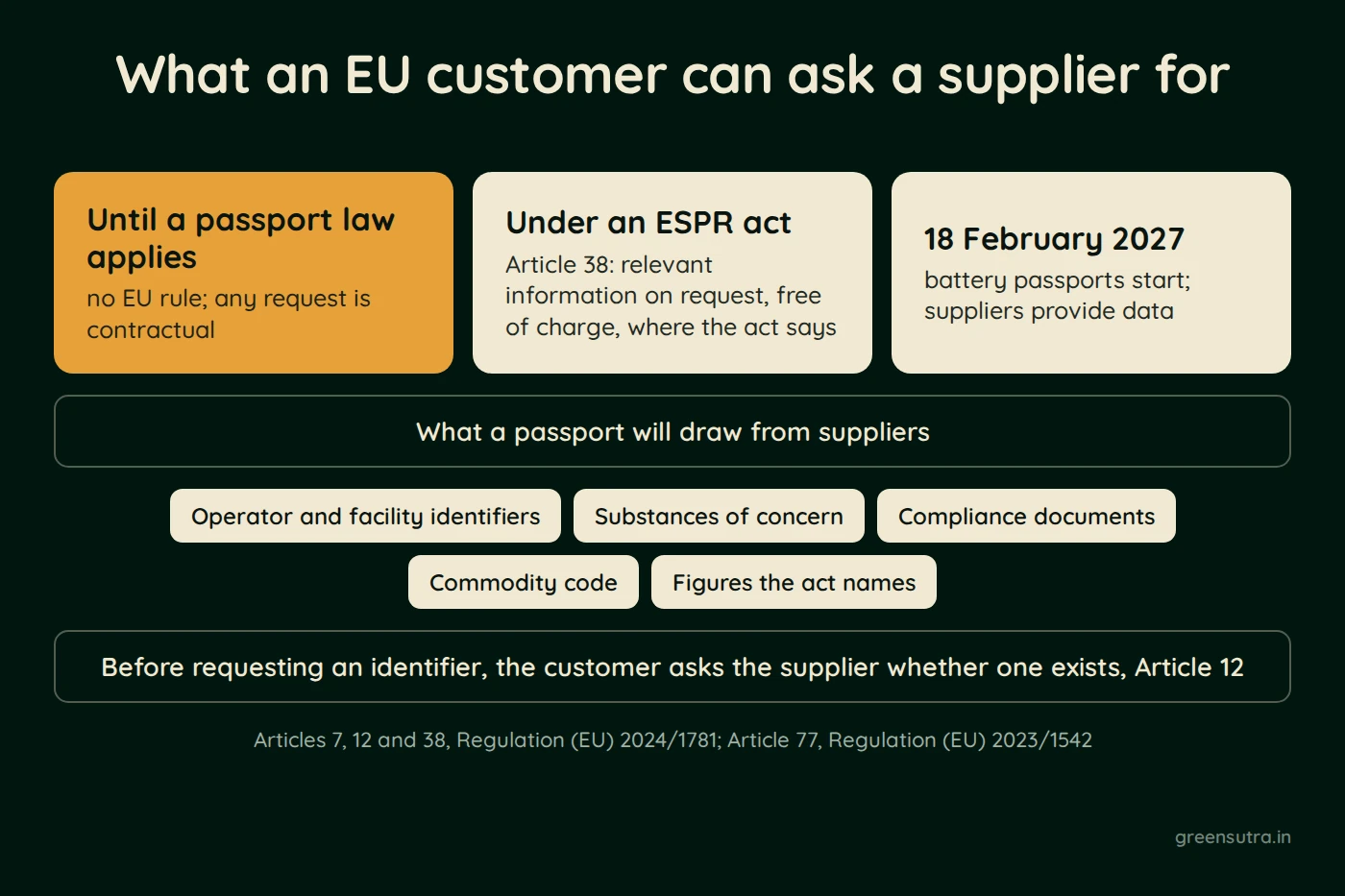
Until a Digital Product Passport law applies to a product, no EU rule fixes what an EU customer may ask a supplier outside the EU for; any request is contractual. The laws show what passports will draw from suppliers: operator and site identifiers, material and substance data, and compliance documents. Battery passports apply from 18 February 2027.
Must a supplier outside the EU hand over passport data now?
No. The passport duty sits with the business placing the product on the EU market. Under the ESPR, Regulation (EU) 2024/1781, that is the manufacturer and, for goods made outside the EU, also the importer, once a delegated act covers the product. ESPR Article 38 obliges supply chain actors to share relevant information on request, free of charge, only “when specified in the delegated act”. No ESPR product act existed on 19 October 2026, so components and their suppliers have no passport duty yet.
What will a passport draw from suppliers?
Each product act picks from ESPR Annex III.
| Passport data | ESPR basis | What the supplier provides |
|---|---|---|
| Operator and facility identifiers | Annex III (h), (i) | Its own and its sites’ identifiers, if any |
| Substances of concern | Article 7(5) | Name or number, location in the product, concentration or range |
| Compliance documents | Annex III (e) | Declaration of conformity, technical documentation, certificates |
| Commodity code | Annex III (d) | A code such as the TARIC code |
| Environmental figures | Article 7(2)(b) | Only what the act names, such as a carbon footprint |
Under Article 12(2) and (3), before requesting a supplier’s identifier, the business creating the passport “shall seek confirmation from that relevant actor that no unique operator identifier exists”. The same applies to site identifiers. If none exists, the customer requests the unique identifier on the supplier’s behalf.
What does a battery passport draw from suppliers?
From 18 February 2027, Article 77 of Regulation (EU) 2023/1542 requires a passport for each LMT battery, each industrial battery above 2 kWh and each electric vehicle battery. Its public part includes material composition, hazardous substances and critical raw materials. Persons with a legitimate interest see cathode, anode and electrolyte materials and component part numbers.
The Commission’s batteries page puts the duty on the business placing the finished battery on the market, “rather than suppliers of individual components or modules”. Cell and module suppliers provide data; they do not create the battery passport.
What might a steel buyer need?
Example: a coil producer outside the EU sells hot-rolled coil to an EU importer. No steel act exists. A Joint Research Centre study of March 2026 proposes that a steel passport carry the heat number and the producer’s operator and facility identifiers. Under ESPR Article 12, the importer would first ask whether those identifiers exist.
Will shared data become public?
Not by default. Under ESPR Article 9(2)(f), each act sets who may see which data. Article 11 bars service providers from selling or reusing it beyond what is needed, unless agreed.
Sources: ESPR, Regulation (EU) 2024/1781, Regulation (EU) 2023/1542, DPP for batteries, JRC steel DPP study
For a supplier, GreenSutra’s DPP consulting starts with the customer’s request and the supplier’s existing product records. The DPP guide tracks which acts apply.