

There is no EU-wide fine. Each EU country sets its own penalties for a missing Digital Product Passport (DPP), and EU law only says they must be effective, proportionate and dissuasive. The bigger risk is practical. A product without its passport can be ordered off the market, and once the customs check is running, it can be stopped at the border.
What can authorities actually do?
For a missed formal requirement, the authority first orders the business to put it right. If it does not, the authority can restrict or ban sales, or have the product withdrawn from shops or recalled from buyers. Every EU country must also be able to fine, and, under the current Ecodesign Regulation, shut a business out of public tenders for a time. A Commission proposal of 9 September 2026 would make that tender exclusion optional. This route covers any administrative requirement in the manufacturer’s and importer’s duties, and the passport duty sits among them.
What happens at the border?
Covered goods are released only after customs match the product’s registration identifier and commodity code against the EU passport registry. The automatic version of that check is due by 6 August 2030. Even before then, customs must hold goods that lack the documents their law requires.
When does any of this start?
Only once a passport duty applies to the product. As of October 2026, no product group under the Ecodesign Regulation has one. Other laws come with their own dates:
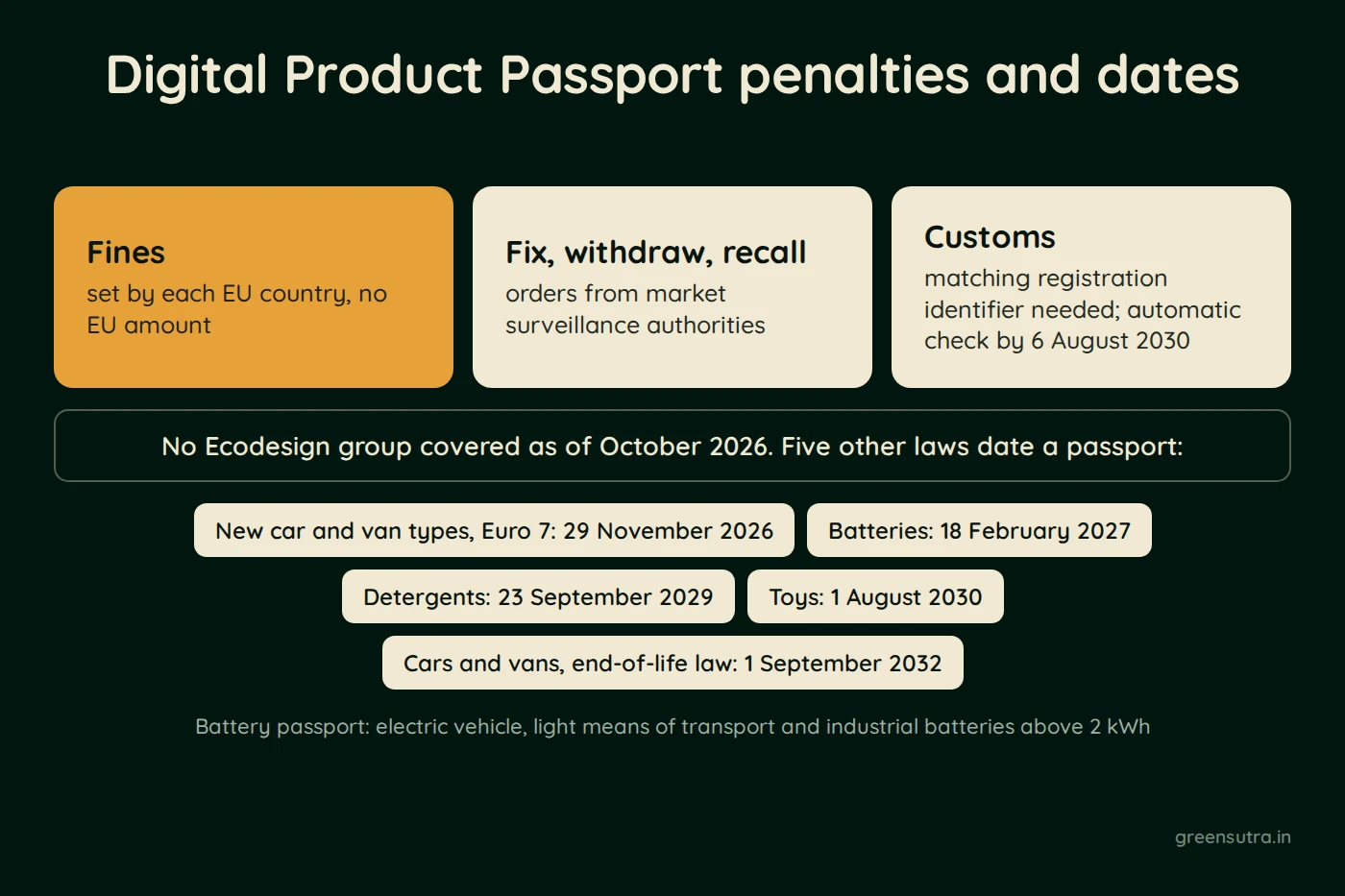
- new car and van types under Euro 7: from 29 November 2026
- electric vehicle, light means of transport and industrial batteries above 2 kWh: from 18 February 2027
- detergents: from 23 September 2029
- toys: from 1 August 2030
- cars and vans under the end-of-life vehicles law: from 1 September 2032
For detergents and toys, the law lists a missing passport as formal non-compliance in its own right.
Who can be penalised?
Any business that misses its own passport duty: the manufacturer, the importer, distributors and dealers each have one. An importer or distributor that sells a product under its own name or brand is treated as the manufacturer.
Where this comes from: Ecodesign Regulation (EU) 2024/1781, Articles 15, 27 to 31, 34, 66, 69, 71 and 74; Regulation (EU) 2019/1020, Article 26; Battery Regulation Article 93; Detergents Regulation Articles 29 and 33; Toy Safety Regulation Articles 47 and 55; proposal COM(2026) 590.